 UK: 0844 854 9218 | International: +44 (0)1488 580017
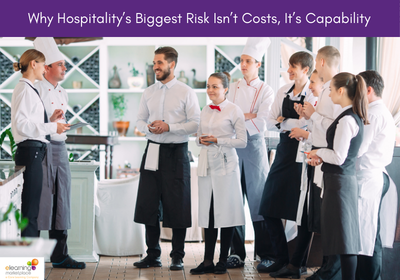
As UK hospitality businesses brace for April cost increases, most conversations focus on numbers. But there’s a quieter, more dangerous risk emerging: capability loss inside already stretched teams. This article explores why that matters, how it’s already showing up, and what operators can do differently.
What Cost Pressures are UK Hospitality Businesses Facing?
Another UK budget announcement at the end of last year and another wave of headlines putting the hospitality industry under pressure. As businesses move into February, many operators are already looking ahead to April, when changes to the business rates, national minimum wage, national insurance and other rising costs are due to come into effect.

For hotels, restaurants and pubs across the UK, the conversations are all too familiar: increasing fixed costs, growing wage bills and tighter margins, all whilst asking how they can absorb it all without passing everything on to the guest.
Recently, political commentary has added another layer of uncertainty. Whilst there has been discussion of further financial support for pubs, comments from Rachel Reeves suggest restaurants and hotels will not be included in any wider business rates rescue packages. For many operators, this reinforces a familiar reality. Support is likely to be minimal or non-existent, the timelines are unclear and the ultimate decisions are increasingly left in the hands of the individual businesses.
The pressures of these are real and, for many, unavoidable.
How is the Changing Hospitality Environment Impacting Businesses?
In our opinion, as April approaches, there is a quieter risk emerging alongside the numbers, one that doesn’t appear on the balance sheet straight away.
That risk is capability; the erosion of skills, confidence and decision-making capacity.
Hospitality teams have always worked hard; what’s changed is the environment they’re operating in. Since 2020, teams are leaner. The job roles are far broader, managers are carrying more responsibility and require skills not previously or traditionally required, and guests are spending more selectively but expecting standout experiences when they do.
Leaders are being asked to keep teams engaged, maintain standards, develop future talent and deliver consistently, often with fewer people and less margin for error. With April on the horizon, many teams are already feeling the anticipation of change through cost reviews, rota adjustments, tightening of performance expectations, but also unfortunately, redundancy.

In that environment, something starts to slip, not effort, but confidence.
The impact is already showing up in the workforce. This pressure isn’t theoretical; it’s already visible in employment data.
According to the Office for National Statistics and figures reported in the trade press, figures show that hospitality employed almost 9000 fewer people in December following the November budget, a time when it would usually be ramping up recruitment ready for the busy festive season.
This means even leaner teams than they were operating in before. And fewer people means less shared knowledge, reduced skills and lower operational confidence, resulting in a measurable drop in organisational capability.
When these capability gaps appear, they appear everywhere.
Why does Cutting Training Increase Costs Elsewhere?
Most of the challenges experienced aren’t caused by a lack of care or commitment. Hospitality workers are and have always been some of the most resilient during tough times. These are capability gaps created under extreme pressure.
They are showing up where team members are promoted far too quickly just to retain them, without any development or leadership support. This leads to teams unsure how to handle basic guest interactions, inconsistencies in standards appearing between sites or shifts, or training that exists but doesn’t translate into day-to-day behaviour.

Over time, these gaps will surface as higher turnover for those who are left, more complaints, stretched managers and a culture that feels reactive rather than confident.
And the irony is this, when costs rise, training is and has always been one of the first things paused, even though it’s one of the few investments that helps teams cope when pressure increases.
Cutting this training doesn’t remove the cost from your P&L, it just moves it elsewhere, shifting it into areas like recruitment, onboarding, service recovery, absenteeism and burnout.
In saying that, there are some standout businesses that aren’t following this suit but are not training for the sake of it. They’re training smarter.
They are focusing on practical skills people can use immediately, whether core technical job mastery or leadership confidence, rather than tick-box compliance. Learning that supports consistency across teams and locations.
This is why putting in place flexible learning matters now.
Why Traditional Hospitality Training Models No Longer Fit
For many businesses, traditional training models no longer fit operational reality and haven’t for a while. Time away from the floor is limited, and with managers balancing operational delivery with people responsibility, it is imperative that learning is accessible, relevant and realistic.

This isn’t me saying learning has to be a 100% digital model, we have tried that and it doesn’t work – it must be a blended approach. The best models are combining digital learning with practical application and human insights. The quality of this content is fundamental. When the learning is designed by experts in that field, the training stops being felt like ‘extra’ and more like genuine support.
Capability Is the Competitive Advantage That Endures
Capability is what will help businesses weather the change.
Budgets have and will always change. Costs have and will dip and rise. Markets shift all the time. What remains constant is the need for confident managers, skilled teams, consistent guest experiences and people who feel supported rather than stretched to their very thinnest.
The hospitality industry has survived recessions, national crises, PR disasters and a global pandemic. Resilience is in its DNA and always will be. As hospitality moves into another period of adjustment this spring, the businesses that come through strongest won’t necessarily be the biggest or most resourced.
It will be the ones who choose to invest in their people before temporary but extreme pressure becomes permanent.
Author: Jenni Clarke, FLPI, Organisational Development Partner, Direction Training Associates Ltd (Hospitality Specialists)