 UK: 0844 854 9218 | International: +44 (0)1488 580017

Workplace mentoring has become a powerful strategy for developing talent, strengthening organisational culture, and driving long-term business success. Done well, mentoring creates meaningful connections, speeds up learning, and supports staff through each phase of their development. This Ultimate Guide explores exactly what workplace mentoring involves, why it holds so much value, and sets out the practical steps organisations can take to set up a mentorship programme that really makes a difference.
Understanding Workplace Mentoring
Mentoring in the workplace can be a structured programme or more of an informal relationship between a mentor, a more experienced person, and a less experienced individual, the mentee. The mentor offers insight and encouragement to the mentee, supporting professional growth, building confidence and career development.
Trust forms the basis of mentoring relationships, along with honest talk and mutual respect. Depending on the goals of the mentoring programme, a mentor might guide a mentee across departments or seniority levels.

A formally structured mentoring programme is an organisation-wide, planned initiative that has clear goals, governance, and measurable outcomes. It is usually designed, supported, and evaluated by an HR or Learning and Development (L&D) team, who ensure the programme’s consistency, quality, and success.
An informal mentoring programme is a flexible, relationship-led approach to mentoring that encourages employees to build mentoring relationships naturally, with minimal structure or oversight from HR or L&D.
The Importance of Mentoring for Employee Development
Mentoring can play a critical role in professional development as it goes beyond formal training, offering tailored one-to-one support with honest feedback as the mentee navigates their way through challenges and opportunities. An experienced mentor’s insights into how to handle real work events are invaluable to the mentee, enabling them to make the right choices and progress faster and more effectively. These insights are rarely captured in training manuals or courses.

For new employees, mentoring offers a safe, non-judgemental space to ask questions and gain reassurance during their early days in employment, which can be invaluable. They can gain clarity on ways of working, what to prioritise and what is expected of them. Mentoring helps them develop a sense of belonging, build relationships and feel welcomed and included.
For those who are more experienced employees, mentoring can enable them to find clarity on the way forward in their careers. They can gain alternative viewpoints and ways of thinking, consider new approaches to problem-solving or their leadership style. Their mentor may encourage them to challenge their long-held assumptions and to think more innovatively.
As the mentor, the process can help the experienced employee retain critical knowledge, strengthen leadership capability, sustain long-term performance and adapt to change. They will strengthen skills such as active listening, empathy, giving quality feedback and developing others. Passing on organisational knowledge and sharing best practices and lessons learned can be a very positive and meaningful experience for mentors, reinforcing a sense of value and purpose.
Benefits of Mentoring for Organisations
When organisations invest in mentoring, they gain in several ways.
- Employees tend to stay longer with the organisation and are more engaged and satisfied in their roles when they receive quality mentoring
- Leadership growth is boosted when experienced mentors support rising talent
- Knowledge flows better, breaking down barriers while keeping organisational expertise intact, such as best practices, lessons learned and critical expertise held by experienced employees
- Organisational continuity is strengthened with clear development paths for employees
- There is better diversity and inclusion when everyone is supported with professional development opportunities
- Through regular interaction, mentors help shape how people think about values and teamwork within the organisation. This results in better performance and productivity
- Organisational culture is strengthened through championing trust, collaboration and shared purpose.
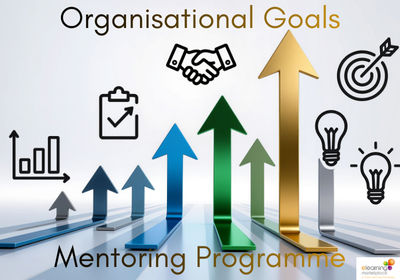
For HR and L&D teams, mentoring is a strategic development tool that requires a relatively low investment and supports both immediate workforce needs and long-term organisational goals. It therefore offers a good return on investment when aligned with organisational objectives.
Types of Workplace Mentoring Programmes
There is no one-size-fits-all mentoring model, so it’s a case of choosing the model that meets the organisation’s objectives. Mentoring programmes are generally categorised based on the structure of the relationship (between mentor and mentee) and the purpose they serve:
Relationship and Structure
- Formal One-to-One Mentoring: This type of mentorship is the most common across all industries and is established as a formal programme with defined goals, timelines and processes. It involves a single match, where one experienced person, the mentor, supports another less experienced person, the mentee. The mentoring path focuses on tailored support, helping the mentee grow in their role and career, and improve specific abilities.
- Informal One-to-One Mentoring: A relationship that develops naturally through mutual respect between an experienced and less experienced individual. This type of relationship often evolves organically as the mentee grows in their role.
- Group Mentoring: A single mentor supports a small group of mentees at once. This model makes the most of the mentor’s time and can build shared insights, bringing different angles into play.
- Mentoring Circles (or Affinity Circles): A group that usually includes several people at different levels, led by a moderator, who gather to talk through a shared topic or aim. These sessions follow an open format where everyone joins in together. The model focuses on building connections, networking through conversations and learning from one another.
- Peer mentoring: An informal mentoring model that involves individuals with similar experience levels or career stages who mentor each other. The focus is on helping one another as they have a shared understanding of common challenges and grow together by learning from one another.
- Team mentoring: Mentorship that happens through teams where experienced mentors support mentees working together on a shared goal or project. This can provide diverse support and collaboration between mentors and mentees, which can be beneficial to achieving the shared objectives.
- Flash mentoring: Sometimes called micro-mentoring, is quick, targeted advice, maybe just fifteen minutes, at the time it is needed by the mentee. It could be a one-off discussion on a particular skill or issue that is being experienced.
- Virtual mentoring: This can be a formal or informal model that is conducted via online platforms. It breaks down geographical barriers, enabling the best, most experienced individual in an organisation to mentor a mentee, despite their location. The model also offers maximum flexibility for the mentor and mentee.
Purpose
Purpose-based mentoring focuses on using formal mentoring as a tool to achieve a clear organisational or personal goal.
- Onboarding Mentoring: Pairing a new employee, the mentee, with a more experienced employee, the mentor or “buddy”, to help the new employee settle into their role and to get used to the company culture.
- Leadership Development Mentoring: Assigning an experienced manager, the mentor, to an identified employee with potential leadership skills, the mentee, to prepare them for a future leadership role.
- Reverse Mentoring: A less experienced individual with specific knowledge or skills, e.g. latest technology, artificial intelligence, mentors a senior leader to transfer knowledge up the organisation.
- Cross-Functional Mentoring: Often carried out as group mentoring to build collaboration and understanding across departments. This can break down silos within an organisation, increase trust across the organisation and improve efficiency.

Once an organisation has defined its objectives for setting up a mentoring programme, it may want to combine several of the above models to create a flexible and inclusive mentoring ecosystem that meets its requirements.
How to Establish a Successful Workplace Mentoring Programme
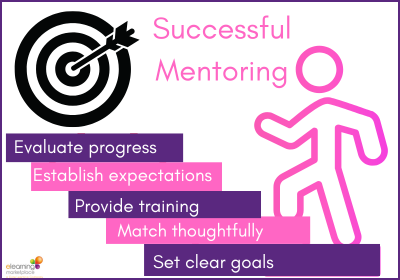
A successful mentoring programme is well planned and starts with a good understanding of its purpose, and like any cross-organisational project, it will need senior leadership support and should align with the organisation’s business strategies, e.g. learning and development, HR and the overall business strategy. Once the SMART (Specific, Measurable, Attainable, Relevant, Time-bound) objectives of the mentoring programme have been identified, additional details need to be included:
- Quantifiable success metrics (KPIs), so that the programme can be properly evaluated, including measuring success, for example:
- Retention rates
- Engagement rates
- Satisfaction scores
- Time to promotion
- Criteria for becoming a mentor and mentee, e.g. skills, experience, characteristics
- How mentors and mentees will be matched. Will it be manager-led or self-matching? It works best if the match focuses on complementary goals and compatible personalities
- Training for mentor and mentee – don’t assume that participants will know how to mentor or be mentored. Online training can be an effective and cost-effective option.
- Time commitments
- Confidentiality
- Resources required to include a programme handbook with goal-setting templates, rules, timeline, and suggested topics for meetings. The mentor and mentee should also know the procedure to follow if the mentor/mentee match is not working.
- A mentoring programme champion can really help commitment and visibility across the organisation.
Workplace Mentoring Programme Successes
One factor consistently linked to the success of Fortune 500 companies, according to MentorcliQ 2024 Mentoring Impact Report, is the 98% adoption of mentoring programmes.
According to Women Ahead, National Mentoring Day, 87% of mentors and mentees feel empowered by their mentoring relationship, bringing greater confidence and career satisfaction.
In a Harvard Business Review, it was found that 89% of employees with mentors say colleagues value their work vs. 75% without mentors
National Mentoring Day evidence sources have found that 55% of businesses felt that mentoring had a positive impact on their profits. They also found that employees who received mentoring were promoted five times more often than those who didn’t have mentors. Impressively, 84% of CEO’s in formal mentoring programmes said mentors had helped them avoid costly mistakes and become proficient in their roles.
A successful mentorship programme in care training was implemented by Harmony Care Services. “Over a six-month period, mentees reported significant improvements in their practical skills and confidence levels. The programme also led to a noticeable increase in job satisfaction and a reduction in staff turnover”.
Gartner research shows that a mentorship programme at Sun Microsystems increased employee retention by 20% over several years, generating $6.7 million in savings.
Key Qualities of an Effective Mentor
An effective mentor has many qualities that can be grouped into three main categories: professional expertise, mindset and relational skills. Let’s start with relational skills, which are the foundation for trust and are often referred to as soft skills:

- Active listener
- Excellent communicator
- Reliable
- Resonsive
- Non-judgemental
- Empathetic
- Integrity
Let’s now take a look at professional expertise, the source of guidance:
- Relevant depth of experience and knowledge
- Organisation savvy might sound a little strange, but a good mentor understands the nuances of the culture and internal politics of the organisation
- Networking experience to be able to introduce the mentee to key people
- A good role model to be able to lead by example
- Provide constructive feedback
Finally, mindset, the source of empowerment:
- Mentoring is focused entirely on the mentee’s agenda and goals
- Empower, don’t direct, so that the mentee thinks critically for themselves and comes up with solutions through powerful, open-ended questions. This will give the mentee confidence and independence to succeed
- Have a growth mindset in respect of the mentee and themselves, as the relationship will benefit from both being open to learn from one another.
- Have patience and endurance to encourage the mentee through failures and celebrate successes, and maintain a positive outlook throughout the journey
It is not just the mentor that has a defined role in a mentoring programme, the mentee does too. They need to take ownership of their role in the programme, be open to feedback and new perspectives, and be appreciative of the mentor’s input.
Measuring the Impact of Mentoring on Employee Performance
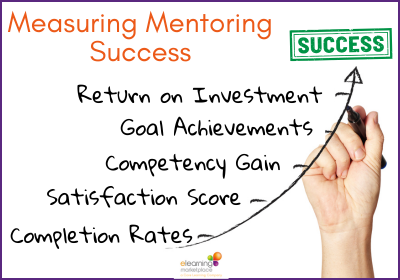
As mentioned above, it’s really important to measure the impact of a mentoring programme. Just asking the mentor and mentee a few questions isn’t going to sufficiently quantify the impact on the organisation and participants. The measures can be obtained through qualitative and quantitative methods.
Activity and Learning
- Participation Rate – number of participants divided by total eligible employees, multiplied by 100
- Retention and Completion Rates – % of participants that complete the programme
- Engagement – documented interactions
- Match Quality Score – mentor and mentee survey
- Satisfaction Score – mentor and mentee survey
- Goal Achievement – % of mentees who achieve their mentoring goals
- Competency Gain – pre- and post-programme assessments, self-evaluations, manager reviews, mentor feedback
- Self-Confidence – mentee survey
Organisational Impact and Return on Investment
- Employee Retention Rate – compare the 12-month retention rate of participants before and after the mentoring programme
- Promotion Rate – compare the % of participants who were promoted before and after the programme
- Employee Engagement Score – compare programme participants to employees who did not participate
- Calculate ROI – Retention savings plus productivity gains, less programme costs, divided by programme costs.
Conclusion
Workplace mentoring is a strong investment in people, their continuous learning and the building of solid relationships, and future-ready talent that can help organisations thrive in our ever-changing world. Yes, of course, there can be challenges, but if mentoring is embedded into organisational culture, supported by leadership, embraced by employees, and aligned with strategic goals, it becomes more than a programme. It becomes a catalyst for growth, inclusion, and long-term success.
Author: Carolyn Lewis
You may also like: