 UK: 0844 854 9218 | International: +44 (0)1488 580017
Most organisations are rarely required to consider security and terrorism preparedness, which has led to a substantial awareness gap regarding Martyn’s Law across many UK sectors. Research and industry feedback consistently indicate that while large venues like stadiums are generally aware, a vast number of smaller or less “obvious” organisations are either unaware of the legislation or incorrectly assume it doesn’t apply to them. This guide outlines the legislation and how it will affect organisations. We have tried to outline as much information as possible to give organisations a clear understanding of Martyn’s Law and what steps they need to take in order to prepare for the legislation coming into force.
Martyn’s Law legislation means all organisations across the UK, such as businesses, charities and educational establishments that meet certain criteria, are now required to consider how to deal with a terrorist attack and how to protect customers and users of premises in the event of an attack.

What Is Martyn’s Law?
Martyn’s Law was introduced to improve public safety in the event of a terrorist attack on publicly accessible premises. Officially named the Terrorism (Protection of Premises) Act 2025, the legislation received Royal Assent in April 2025. It is due to come into force in two years, with the UK Government having established a 24-month transition period to allow venues and event organisers time to prepare. When it does come into force, organisations responsible for publicly accessible premises and events that hold 200 or more people at any one time will have a statutory duty of preparation to protect their customers from a terrorist attack.
Most terrorist attacks will take place in locations that are open to the public, such as places of public resort (hotels, shops, etc.). To reduce the number of people killed or injured, businesses with premises open to the public that are likely to contain 200 or more individuals at one time will be required to have plans in place to deal with a potential attack.
This legislation is not simply about physical security measures but also about being prepared, aware and provide an effective response in order to reduce harm and save lives.
Why Has Martyn’s Law Been Introduced?
Whilst we all hope terrorism will never happen in this country, there are always those who would seek to cause destruction. History has shown us that by planning and putting in place the correct procedures and having the right personnel to deal with an incident, the damage and loss of life can be reduced. Government guidance that sets out the implementation of the legislation points out that organisations are more likely to reduce harm to the public and save lives if they have thought through the potential scenarios for a terrorist attack and put in place measures to deal with them. For many organisations, Martyn’s Law will require them to think about terrorism preparedness in more detail within their existing emergency planning arrangements for critical incidents and fire.

For many organisations, Martyn’s Law will simply reinforce what already needs to be in place. In terms of new processes and procedures, much of the groundwork will have already been covered, specifically in relation to emergency planning and business continuity.
Martyn’s Law will look to ensure that terrorism has been given due consideration in the development of such procedures, and that all personnel have been trained appropriately in how to respond in the event of an attack.
Which Organisations Are Affected?
What organisations does Martyn’s Law apply to? The legislation covers a wide variety of publicly accessible locations where there are likely to be more than 200 people at the same time. These could include:
- Retail and Shopping Facilities
- Education Providers
- Hospitality Sector
- Leisure and Entertainment Venues
- Sports Venues
- Visitor Attractions
- Healthcare Organisations
- Places of Worship
- Public Sector and Government Buildings
- Transport and Travel Facilities
- Event Organisers
- Cultural and Community Venues
- Commercial Premises with public access
So if you are an organisation that expects 200 or more individuals (including both staff, contractors, volunteers and the public) to be present on your premises at the same time for a ‘qualifying activity’, you must comply with Martyn’s Law. For example, if you have 180 staff and 20 visitors, who are required to purchase a ticket or receive a pass to access the premises for an event or activity, you are then required to comply with the law.
Martyn’s Law ‘Qualifying Activities’
Organisations must comply with Martyn’s Law if they meet one or multiple of the following qualifying activities:
- The event/activity takes place at premises that is, a building, other land, or a building and other land. This is a wider definition than that applied to qualifying premises as it also includes land without buildings.
- The event/activity is accessible to the public
- It is reasonable to expect that, at some point during the event/activity, 800 or more individuals may be present on the premises at the same time in connection with their use for the event
- The event/activity has measures in place to check that attendees satisfy an entry condition
- The event/activity is not taking place at excluded premises, which includes premises that are strictly private residential premises or non-public areas of offices restricted solely to employees.
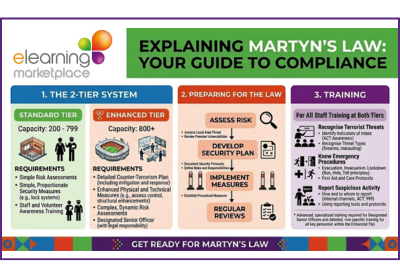
Understanding the Two Compliance Tiers of Martyn’s Law
In summary, the two tiers of compliance as set out by Martyn’s Law are based upon the number of people that are expected to be at any given time at any given premises.
Standard Tier Premises
Between 200 and 799 individuals may be reasonably expected to be present at any time at premises within the Standard Tier (i.e. ‘the usual’ premises). Such premises will establish practical public protection measures (e.g. evacuation; lock down; communications in an emergency, staff aware of what to do in an emergency and trained as necessary). Many of these measures would be included in the health and safety measures and emergency planning that an organisation already has in place.
For organisations that fall within the Standard Tier (200-799 people), organisations will be required to put in place some basic public protection measures, such as:
- Evacuation arrangements
- Staff awareness and training
- Lockdown procedures
- Emergency communications
For many organisations, this will form part of their current Health and Safety Policy and arrangements for Emergency Planning.
Enhanced Tier Premises and Events
For premises or events where 800 or more individuals may reasonably be expected to be present at any one time, Enhanced Tier measures will apply. These organisations will have additional responsibilities, including:
- Conducting terrorism risk assessments
- Documenting security measures
- Reviewing site vulnerabilities
- Implementing proportionate protective security arrangements
- Demonstrating ongoing compliance
The intention behind the Enhanced Tier is to ensure that venues and events of this size take a structured approach to managing risks and protecting the public.
What Should Organisations Be Doing Now?
Although the implementation is done in phases, it is important for organisations to start preparing as early as possible and not wait until a few months before the deadline for implementation of the required measures.

Preparing in good time for the implementation of the new legislation allows businesses to have time to identify any gaps in the security of their premises. It allows for appropriate expenditure to be included in their budgets and the prevention of last-minute unforeseen problems arising to ensure compliance with the legislation.
Practical First Steps
- Review occupancy Levels
- Find out if your premises are likely to fall within the Measure’s thresholds
- Assess existing procedures
- Review your current emergency plans to see if they are sufficient for dealing with a terrorist attack
- Evaluate staff awareness and training requirements.
Most incidents occur when employees are left to deal with a crisis situation, for example, dealing with an emergency when it occurs. Ensuring that all employees are aware of the organisation’s policies and procedures for dealing with incidents, as well as the actions they should take in a specific situation can greatly assist in managing an emergency.
Martyn’s Law Training
The primary objective of the law is to build a “security culture” and ensure staff are operationally ready. The training that is required varies depending on the tier of your organisation:
- Standard Tier: You should focus on basic procedural awareness and ensuring that everyone knows what to do in an emergency
- Enhanced Tier: You will need more formal, documented evidence of staff training, regular drills, and potentially more specialised training for senior individuals and security staff responsible for physical interventions or advanced monitoring.
The most critical part of the training requirement isn’t just the training itself; it’s the record-keeping. To be compliant, you should maintain a simple, updated training log that includes:
- Who was trained (names/roles).
- What they were trained on (e.g., “Lockdown Procedure v1.2” or “Awareness Course”).
- When they were trained.
- When the next refresher is due.
ACT Awareness E-Learning: Developed by Counter Terrorism Policing, this free course teaches you how to respond to terrorist methodologies, mitigate threats, and meet the upcoming legal requirements. You can access it directly via the ProtectUK website.
Conduct a Risk Assessment
Identify the risks and vulnerabilities to your business, your employees, your customers and your visitors.
Seek Specialist Guidance
For larger or more complex venues, it may be beneficial to seek the advice of experts in order to aid your organisation in a compliant, proportionate and effective manner.
Compliance Should Be Seen as More Than a Legal Requirement
The intent behind Martyn’s Law is for larger venues and events to take a structured approach to risk management and public protection. Effective emergency planning not only ensures that your organisation is meeting the requirements of Martyn’s Law, but emergency planning can also be used to improve a company’s business continuity, protect its reputation, and most importantly of all, the people who work for and visit its premises.
The organisations that successfully manage to meet the requirements of Martyn’s Law are those that treat preparedness as an ongoing process and not as a one-off compliance. Understanding your responsibilities now and taking steps to comply will mean your organisation is better prepared, more security aware and can play a part in creating safer spaces for users of all users of premises.
For further guidance on Martyn’s Law go to the UK Government’s Guidance or Protect UK
Author: Carolyn Lewis
Sources:
UK Government
Policy Pros