
 UK: 0844 854 9218 | International: +44 (0)1488 580017
Health and safety training is a legal requirement for organisations across the UK, yet workplace incidents remain alarmingly high. According to the HSE, over 561,000 workers have suffered non-fatal injuries in recent years, alongside thousands of cases of work-related ill health, despite millions being invested annually in compliance training.
So why is health and safety training still failing in so many workplaces?
The answer lies in a growing disconnect between compliance and effectiveness. Many organisations focus on completing mandatory training and achieving certification, rather than ensuring employees actually understand, retain, and apply what they’ve learned in real-world situations.
In this article, we explore why traditional health and safety training is falling short, how learning decay impacts workplace behaviour, and what organisations in the UK can do to improve safety outcomes through more engaging, relevant, and continuous training approaches.
The Illusion of Compliance
Compliance is often a major priority in organisations. Employees complete training programmes, assessments are passed, and, importantly, certificates are issued. Seen from a transactional perspective, everything seems to be in order. However, having completed the training is no guarantee that the learner will understand how the findings might apply to them or that they will go on to make changes as a result. Compliance-driven training often prioritises:
- Course completion rates
- Pass marks
- Audit readiness.
Although these are all crucial, do they measure learning application?

| Metric | Compliance Training | Effective Training |
| Focus | Completion | Behaviour change |
| Measurement | Pass rates | Real world outcomes |
| Frequency | Annual | Continuous |
| Relevance | Generic | Role-specific |
The gap between compliance and real-world safety is an area where many organisations fall short.
Why Traditional Training Falls Short
Traditional workplace training often follows a standard format: a generic course delivered once a year, with limited interaction and minimal follow-up. Not as effective as it could be. There are several reasons why this is. Firstly, the content provided is too broad. One course should not be expected to cover all roles, environments and risks, as it reduces its relevance for individual employees. Most importantly, your employees are not going to be actively engaged with the training. They are likely to view it as a tick-box exercise. Secondly, if your training module is purely text or slides, the chances are the learner will struggle to absorb what you’re delivering. Thirdly, training is rarely reinforced: Once a course is completed, it is often not revisited until the following year.
| Training Method | Engagement Level | Retention Level |
| Text-heavy modules | Low | Low |
| Slide-based e-learning | Medium | Low |
| Video-based training | Medium | Medium |
| Interactive learning | High | High |
One of the biggest challenges with standard non-interactive training is that even after training is completed, there is typically very little retention of what was learned.
The Problem of Learning Decay
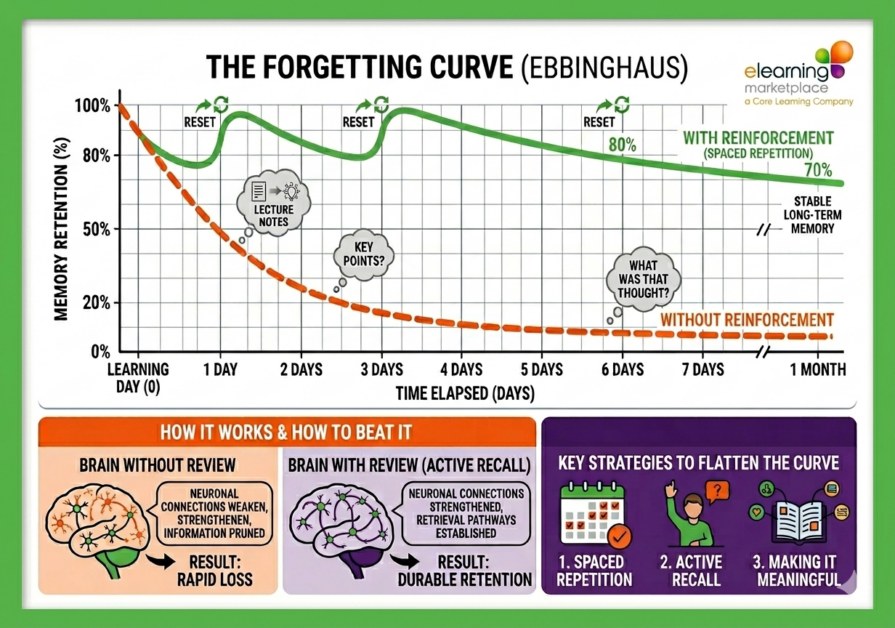
One of the greatest challenges of training in the workplace is helping workers to retain knowledge so that it can be applied in their job roles. Knowledge retention and applied skills translate into higher-performing employees. However, unless reinforced, learning has a rather steep drop-off in effectiveness. Studies show that there is a massive loss of information over time, referred to as the “forgetting curve”.
| Time After Training | Knowledge Retained |
| Immediately after training | 100% |
| After 1 week | ~50% |
| After 1 month | ~20% |
| After 3 months | Less that 10% |
In practical terms, this means that courses completed annually are unlikely to have long-term effects on behaviour. Once a well-designed and effective training programme has been established, it is critical that it be consistently reinforced to maintain its value and continue to produce optimal results.
The Importance of Relevance
For training to be effective, it must be relevant to the employee’s role and working environment. A warehouse operative, an office worker and a construction site supervisor all have unique health and safety risks at work. Yet, surprisingly, many organisations provide generic training to staff with very different job requirements. Training that is not relevant to employees’ needs and work activities is unlikely to engage them or encourage them to apply it in practice.
Effective training focuses on:
- real tasks employees perform
- specific risks within their role
- practical scenarios they may encounter
By making the training more relevant, it is more likely to support behaviour change.

Why Frequency Matters
Another key factor in effective training is frequency. Annual training sessions are a means to compliance; however, they are an ineffective method to reinforce previously learned information and to cultivate long-term safety awareness. Keep the training sessions short and regular. This enables employees to return to key topics, risks and situations on a regular basis and adapt to changes in the workplace. Organisations that move to a more continuous approach to learning see real benefits to both employee engagement and safety outcomes.
What Effective Safety Training Looks Like
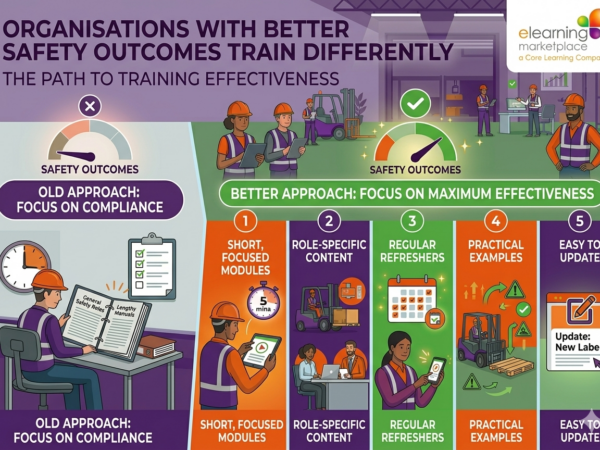
Organisations that achieve better safety outcomes train differently. Rather than just ensuring compliance, they aim for maximum effectiveness. Effective workplace safety training typically includes:
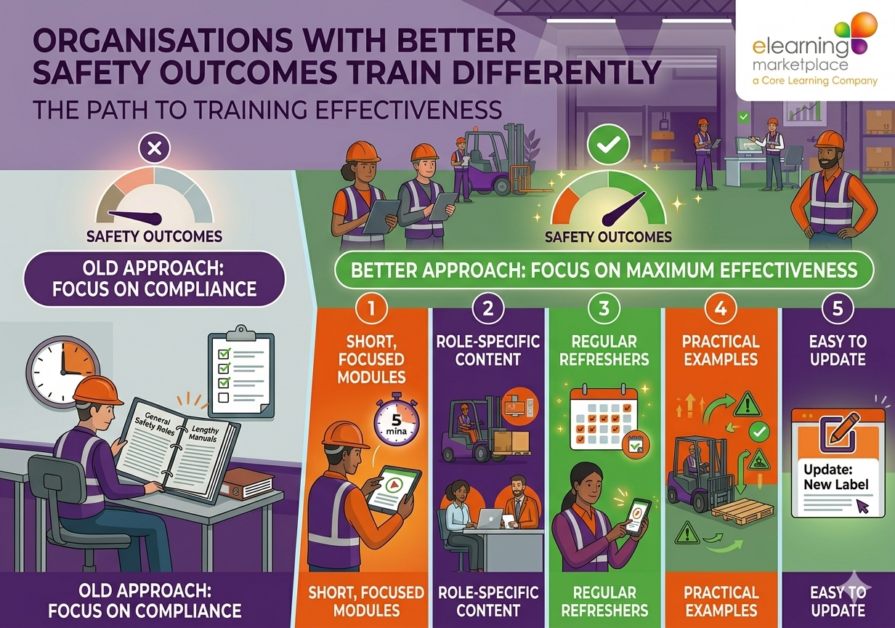
- Short, focused learning modules
- Role-specific content tailored to the employee
- Regular refreshers to reinforce key messages
- Practical examples and real-world scenarios
- Content that is easy to update as procedures change
This approach helps ensure that training remains relevant, engaging and aligned with real workplace risks.
The Shift in Workplace Training
There is a growing trend across industries to move away from traditional training methodologies and towards a more flexible and dynamic model of learning. Unlike the days of ‘train and forget’, forward-thinking organisations are moving away from static courses and towards a more dynamic training methodology that is constantly adapting to the ever-changing environment of the organisation. This includes:
- Updating training more frequently
- Tailoring content to specific roles
- Improving accessibility through digital platforms
- Emphasis on learning, engagement and comprehension, not just completing the training.
As training techniques have evolved, so too has the understanding of how to maximise return on training investment, now widely accepted to require an ongoing, continuous process, rather than a one-time activity.
Turning Health & Safety Training into Real-World Impact
The end goal of providing workplace safety training is not simply to meet compliance standards, but most importantly, it is to help create a workplace safety culture and a safer working environment. When training is relevant, engaging and regularly reinforced, employees are more likely to:
- Recognise hazards
- Follow safe procedures
- Take responsibility for safety
- Contribute to a stronger safety culture

This illustrates how training programmes move beyond mere administration to have measurable effects on organisation-wide performance.
A More Effective Approach to Workplace Health & Safety Training
Improving workplace safety is not just about meeting compliance requirements; it’s about creating lasting behavioural change that reduces risk and protects employees every day.
The evidence is clear: traditional, one-off health and safety training is no longer enough. Without relevance, reinforcement, and ongoing engagement, knowledge fades quickly and unsafe behaviours return.
Organisations that want to improve safety performance should move away from tick-box compliance training and adopt a continuous learning approach that is role-specific, practical, and regularly reinforced. This ensures employees not only complete training but also retain the learned information and apply it in the workplace.
If your organisation is still relying on annual, generic training, now is the time to review your approach. By investing in more effective health and safety training strategies, you can reduce incidents, improve compliance confidence, and build a stronger safety culture across your workforce.
Frequently Asked Questions
Why does workplace safety training often fail?
Training often fails due to low engagement, lack of relevance and infrequent delivery, meaning employees forget key information quickly.
What makes safety training effective?
Effective training is relevant, engaging, regularly reinforced and focused on real-world application.
How often should safety training be delivered?
Training should be continuous, with regular refreshers rather than a single annual course.
Does compliance training improve safety?
Compliance training is important, but it must be combined with effective learning strategies to improve real-world safety outcomes.
Author: First Health and Safety