 UK: 0844 854 9218 | International: +44 (0)1488 580017
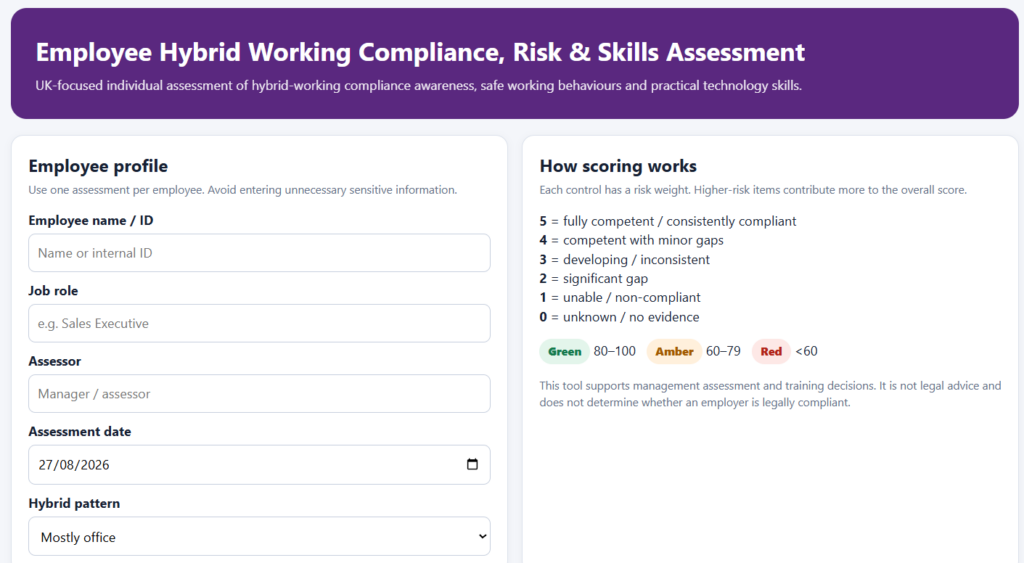
Employee Hybrid Working Compliance, Risk & Skills Assessment
1. What is the SME Hybrid Working & Digital Skills Assessment Tool?
It is a practical employee assessment tool designed to help SMEs evaluate whether individual employees have the knowledge, behaviours and digital skills needed to work effectively and securely in a hybrid working environment.
2. Who is the tool designed for?
The tool is designed primarily for UK SMEs and can be used by managers, HR professionals, L&D teams and business owners to assess employees who work remotely or on a hybrid working basis.
3. What does the assessment cover?
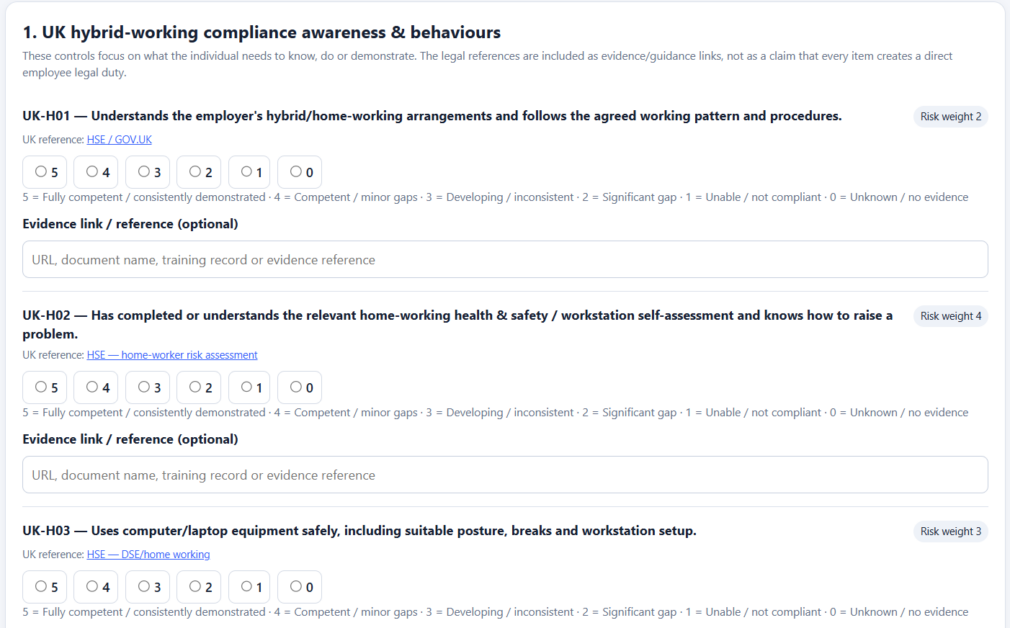
It covers hybrid working compliance awareness and behaviours, data protection, cybersecurity, safe home working, collaboration technology, digital productivity, secure data handling and other practical technology skills.
4. Is the assessment based on UK requirements?
Yes. The tool incorporates UK-focused considerations and links to relevant guidance from organisations including the HSE, ICO, NCSC and GOV.UK. It is designed as an assessment and development aid rather than a substitute for professional legal or compliance advice.
5. How does the risk-weighted scoring work?
Controls are given different weightings according to their potential risk. Higher-risk areas, such as cybersecurity, authentication, confidential data handling and incident reporting, have a greater influence on the employee’s overall assessment score.
6. Does the tool identify employee skills gaps?
Yes. Responses are analysed to highlight areas where an employee may need additional knowledge, training, guidance or practical support, making it easier to prioritise learning and development.
7. Can evidence be recorded against the assessment?
Yes. Evidence can be linked or referenced against individual controls, including training records, policies, documents, assessment results or other supporting information.
8. Does the tool create an action plan?
Yes. Areas requiring improvement are used to generate an individual action plan. SMEs can record priorities, responsibilities and target dates to help turn assessment findings into measurable development activities.
9. How often should employees be reassessed?
A periodic review is recommended, as well as reassessment following significant changes to an employee’s role, working arrangements, technology, company policies or relevant guidance. Reassessment can also be useful after training to demonstrate improvement.
10. Can SMEs reuse or adapt the tool?
Yes. The tool was created by eLearning Marketplace Ltd and is provided under the Creative Commons Attribution-NonCommercial-ShareAlike 4.0 International (CC BY-NC-SA 4.0) licence, allowing appropriate non-commercial use and adaptation subject to the licence conditions.
Resource Download
Sources and references:
HSE / GOV.UK
HSE — home-worker risk assessment
HSE — DSE/home working
HSE — working environment & accidents
HSE — stress & mental health
HSE — lone working
ICO — working from home
ICO — monitoring workers
NCSC — small organisations
NCSC — phishing advice
NCSC — cyber security
GOV.UK — flexible working